

Opening up a Bookshop/Espresso Bar in 2026!
Wacky idea or perfect storm to take a chance?

2026 started with a purpose for me. I decided that after years of mulling it over I’d finally open up a bookshop & espresso bar of my own. If you’re a book girly, this is probably a dream you’ve had too and your version probably includes an animal rescue, a flower shop, and/or a bakery alongside, iykyk. To clarify, yes, I’m a book girly, but no, this dream isn’t part of a fad that bloomed with the rise of booktok and bookstagram. It has been a lifelong dream of mine to create a safe space for myself and others to enjoy the beauty of getting lost in a good book, while ALSO sharing a little bit of my family’s Spanish heritage by making Cuban espressos among other drinks. I’ve never felt safer than when I’m in my own little world, nose deep in a good book, and drinking coffee (or tea!). This is my version of Belle in the Beast’s personal library. It is the dream!
The reality of having a dream like this one though is much different than the fantasy of living it. Entrepreneurship is hard, especially in an industry that has been long since dwindling. To be fair, the rise of booktok and bookstagram has created a huge boost in book sales, the number of indie bookstores opening up, and growth projections for the next 5 years. However, those projections aren’t nearly as optimistic as the ones we’ve lived through the last 5 years. Add in the general risks of retail and the behemoth that is e-commerce (you know who!) and the risk is only going to grow. And have you seen the news lately? Financial bros keep talking recession and darker times than the Great Depression. Other media sources are highlighting governmental abuse and civil unrest, while the other side is gaslighting us. The point is that right now, a month into my decision, it has been an emotional roller coaster.
Still in early stages, about 7-10 months from an opening day, and here are the first 5 things I’ve focused on to turn my idea into a reality.
1. Create a Business Plan
Trust me, it is important.
During my last few weeks of research, I’ve seen mixed reviews on the importance of a business plan. SBA (Small Business Administration) puts a lot of emphasis on creating one, especially so for businesses that require investors or business loans. You need to make your case for why your idea is worth their time and money. However, on the flip side, there is conflicting content out there that says business plans are just a piece of a paper that can roadblock aspiring business owners. Fact: Executing a vision is the difference between dreamers and do’ers. Also a fact, analysis paralysis is real.
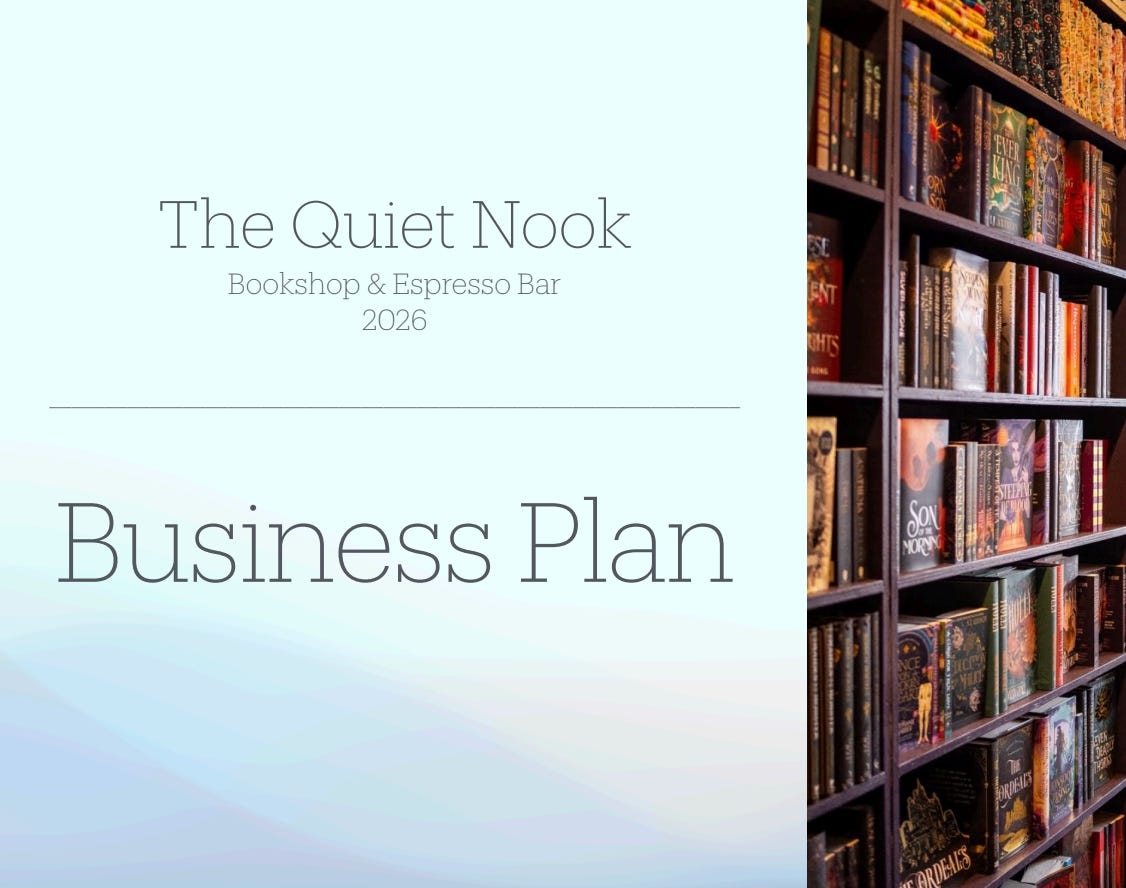
For me, creating a business plan allowed me to lay out the framework for the business, helped me determine high level COGS (cost of goods sold) and expenses, consider realistic financial projections, brought up many questions that I hadn’t thought of, and guided me to set up contingencies if and when things do not go according to plan. All in it took me about 2 weeks to create a business plan, most of it was spent gathering market and financial research and only a couple of days creating the actual slide deck. While we are not seeking outside investments, I did still need to convince my husband that this was a viable project for him to support me both financially and with his time. It was tedious, but worth it so don’t skip it.
2. Prepare to get a mailbox, registered agent, virtual office.
(NOT a PO Box)
Business plan - check! BUT…..hold please.
After the business plan (and my husband’s stamp of approval), I thought I was ready to create an LLC, but I was wrong. Filing Articles of Organization (or whatever is required for your entity type) will require personal information from the owner(s) and in my case for the LLC, a registered agent. All of the information would be mine since my husband and I would own the LLC, so I realized that because I don’t have a physical store location yet (cart before the horse) I’d have to share my home address on these filed documents, which would make it public information. While I don’t foresee any stalkers for the local indie bookshop owner and realistically most of our information is already out there somewhere, I still didn’t feel comfortable including it so freely in the filing for my family’s sake. Hence, a separate mailbox, registered agent, and virtual physical office (for regulatory compliance). The state of California, and the IRS if you apply for an EIN, requires a physical location address, no PO boxes allowed when submitting a filing. Therefore, I had to invest in getting a UPS mailbox, which provides a physical address with a unit number, like an apartment, to be able to use for my entity & working with a registered agent entity like Northwest until my store location is up and running. This step was totally out of left field for me because I didn’t anticipate a security concern so soon. It shouldn’t break the bank, but it is a must.
3. Create your entity.
Yes! Finally.
This is a personal decision based on what works for you - sole proprietorship, partnership, LLC, S-corp, etc. Your choice will impact how you file your taxes in the future, if there are concerns of personal vs. business liability, and how to manage your finances. You’ll need to consider if you want to create your entity in-state or out-of-state. Are you a single one-stop shop or one of many owners? Once you have decided, go to their state website and follow the instructions for creating a new entity. In my case, I chose an LLC so I will focus on that type here. California requires you file your Articles of Organizations with the California Secretary of State. They will review your submission and determine if the entity name is acceptable, and if so, within 1-5 business days you’ll have your LLC formed. Mine was approved today! Yay!
NOTE: You want to have done your due diligence within the state business search website, US Patent & Trademark search website, and more generic nationwide/global searches to ensure your entity name is available before submitting your filing.
A few other reminders in the state of California when creating an LLC:
You’ll need to file a Statement of Information within 90 days of filing your new entity.
Operating Agreement is required but does not require filing.
If you won’t use the LLC name, you’ll need to file with your county to use a DBA or Fictitious Name.
Apply for an EIN with the IRS.
4. Domain & Email Setup
Let’s get techie.
If you recall the recent Kennedy - Trump Center fiasco, you probably saw how a comedian purchased the domain that aligned with the renaming of this facility. All part of some joke, but the reality is that once your desired domain is taken you either have to find an alternate option or ask the owner if they’d be willing to sell it to you. Ideally, you want to start looking into it early, so you can purchase the custom domain you’d like to use for both your future website and business email. Both of these are optional, though they do enhance your business’ professionalism and reach. As for which domain registrar or email provider to use? It depends on your technical skills, price point, and business needs. Some focus on higher cyber security, allowing for more customizations, and others on offering the lowest cost. After much research and knowing my technical skills are limited, I went with Porkbun as my domain registrar (the logo is sooo cute!) and Google for my business email.
5. Logo & Social Media
Where a brand comes to life.
Now that steps #1-4 are done, I’ve started to think about how to bring my business idea to life, make it tangible. The goal is to start building a community of bookshop owners/readers/authors and a mailing list, create an online presence through social media and this journal/diary/blog/whatever it is, and setup an online book store. However, pushing a new brand is hard enough without it adding the fact that at the moment it is a name without a face. We need a logo! (and a color palette + brand kit). I keep envisioning open books swirling around, torn pages falling with a cat or a bunny or both, maybe holding a coffee mug, maybe wearing a guayabera as a nod to the Cuban espressos, and…..on and on. To get the best results, you want to work with a graphic designer, not just AI. You want your logo to capture your vibe, but also be simple, unique, not already proprietary to anyone else or any other business, and you want the logo created on the proper software so it can be used in different media types. But don’t let this deter you from sketching out your ideas and using AI to help you visualize it. It’ll help inspire your graphic designer too.
For now, this step is still in progress for us. We are working with a family friend who is a graphic designer. Hopefully you’ll get to see soon how he helped us take our logo ideas and favorite colors and turned those into a reality. If you don’t have anyone you know with this skill set, look into local or freelance graphic designers.
Passing on the knowledge, hope it helps!